drone

OKLAHOMA CITY – Privacy concerns weigh heavy on the governmental use of UAS. But for farmers in Oklahoma and all around the United States, UAS could be a necessary tool to the future of farming.

“The technology is pretty new to our members but as we go and technology gets stronger I see a huge market for it in the future,” said Oklahoma Farm Bureau’s John Collison.

UAS is already a tool for many Oklahoma Farmers.

“Check their cattle, check their property, use these drone for precision agriculture and make sure we are farming the most efficient and effective way possible,” Collison said.

Oklahoma Farm Bureau’s John Collison still hears concerns from other farmers across the state.

“Farmers want to use these drones in a correct manner and under FAA guidelines and using them correctly,” Collison said.

In an exclusive statement to News 9, the FAA clarified the issue, stating:

“Farmers may operate an unmanned aircraft over their own property for personal use and Guidelines for the operation of model aircraft, such as those published by the Academy of Model Aeronautics, may be used by farmers as reference for safe model UAS operations.”

One priority guideline from the AMA… “(c) Not fly higher than approximately 400 feet above ground level within three (3) miles of an airport without notifying the airport operator.”

“System are much smaller, and has the capability to sense where his crops need to be watered,” said Retired Major General Toney Stricklin.

Retired Major General of the US Army and member of the Oklahoma Unmanned Aircraft Council Toney Stricklin knows the difference between military and commercial drones, and feels farming is just the beginning.

“I Like to say the genie is out of the bottle. This technology will continue to grow in public safety and agriculture,” Stricklin said.

It really is just the beginning. General Stricklin estimates in the next 20 years, UAS will be a multi-billion dollar industry.

Source: Academy of Model Aeronautics National Model Aircraft Safety Code

Multi rotors perform a lot of useful tasks, but here’s one of the best I’ve ever seen. Henry Evans, who has been paralyzed by a type of stroke, uses a quadrotor to navigate space. The aircraft’s FPV view allows Henry to look around a garden or take a stroll across campus and gives him greater accessibility to the world. This is worth watching!

FPV drone lets a paralyzed man stroll outdoors

Source: http://www.ted.com/talks/henry_evans_and_chad_jenkins_meet_the_robots_for_humanity.html

[  For more information about UAV’s positively impacting wildlife, pick up the January/February 2014 issue of Robot Magazine and check out “UAV’s Deployed in Nepal To Save Wildlife”, by Tom Atwood. http://www.botmag.com  ]

BARDIA NATIONAL PARK – Nepal’s antipoaching efforts received a major boost this week as park rangers and army personnel learn how to operate unmanned aerial vehicles (UAVs) in two national parks in a training program organized by WWF.

Nepal is home to rhinos, tigers and elephants, among the world’s most vulnerable species. Poaching of these and many other animals is at an all-time high and the hope is that UAV technology will help capture poachers in the act and deter others from even trying.

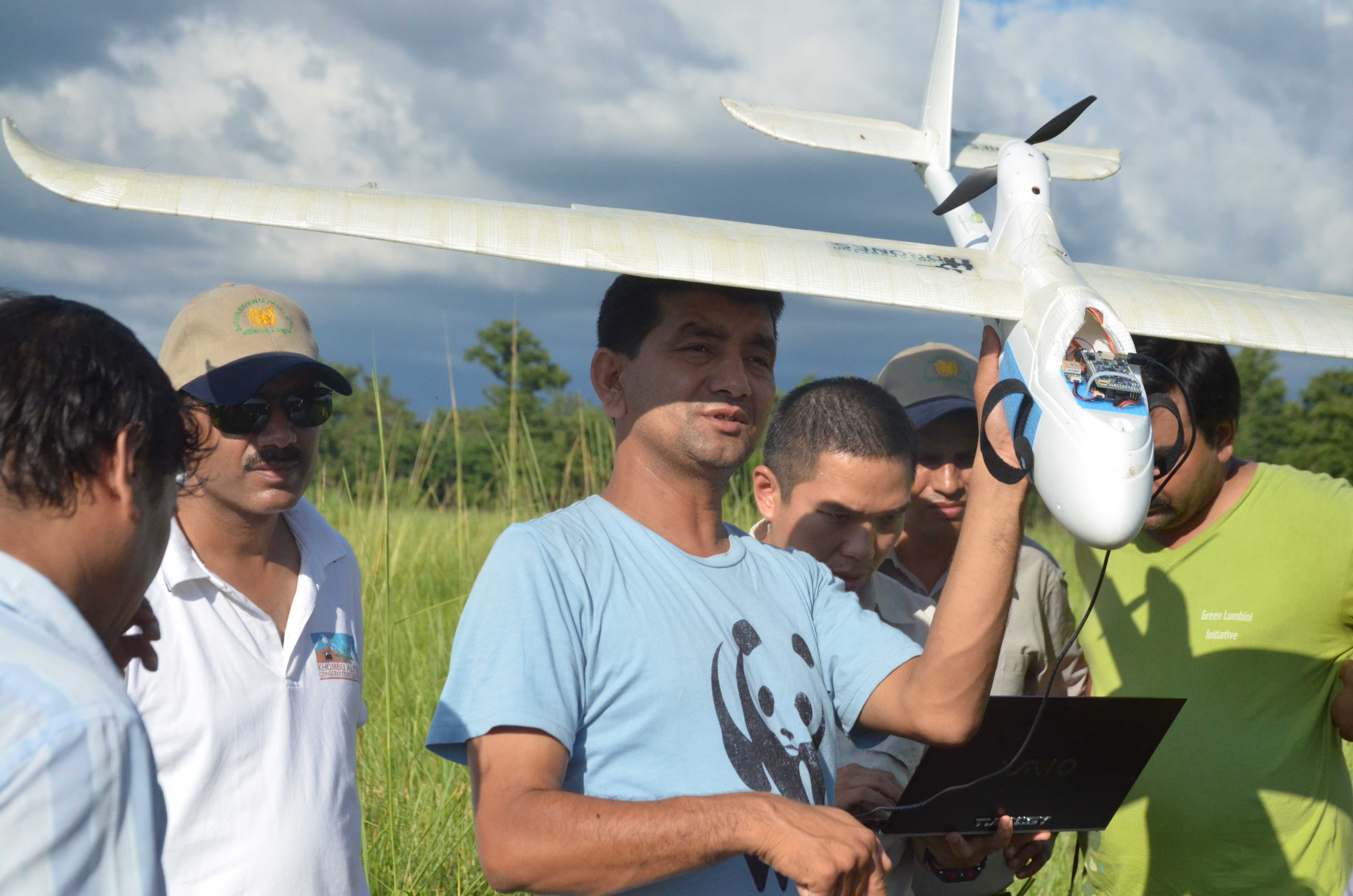
WWF has supported Nepal with training rangers to use unmanned aerial vehicles to monitor for poachers.

WWF has supported Nepal with training rangers to use unmanned aerial vehicles to monitor for poachers.

“Nepal is committed to stopping wildlife crime, which is robbing Nepal of its natural resources, putting the lives of rangers and local communities at risk, and feeding into global criminal networks,” said General Krishna Acharya, Director of Nepal’s Department of National Parks and Wildlife Conservation. “Technologies like these non-lethal UAVs could give our park rangers a vital advantage against dangerously armed poachers.”

Nineteen park rangers and Nepal army personnel were trained to use the UAVs by developer Mr. Lian Pin Koh, an ecologist at the Swiss Federal Institute of Technology Zurich. Participants learned how to use the planes and conducted field tests in Bardia National Park.

Traditionally, effective monitoring of national parks has depended largely on accessibility of the terrain by anti-poaching patrols as well as prior intelligence on poachers in the vicinity.

The UAV gives the patrols a new strategic advantage with an eye in the sky, allowing them access into previously unreachable areas and a safe view of illegal activities on the ground. The presence of a UAV also serves as a deterrent to poachers and illegal loggers since they now know that the parks are being monitored both on the ground and from above.

The GPS-enabled FPV Raptor model planes are light enough to be launched by hand, filming the ground below with a still or video camera. They can fly a pre-programmed route of about 30km at a maximum elevation of 200 meters for up to 50 minutes. The battery can be recharged in about half an hour. Each UAV costs about $2500, making it affordable even for developing countries like Nepal.

“WWF is excited to be part of this field test of new technology in partnership with the government of Nepal,” said Anil Manandhar, Country Representative of WWF Nepal. “We see this as a potentially powerful new tool to improve protection of Nepal’s national parks from illegal activities like poaching and logging.”

Vienna University of Technology’s 'smartphone quadcopter'

Vienna University of Technology’s ‘smartphone quadcopter’

With one possible exception, autonomous quadcopters are not something that you would expect to be inexpensive. A relatively cheap model may indeed be on its way, however. Designed by the Vienna University of Technology’s Virtual Reality Team, the tiny aircraft utilizes the processor and camera of an off-the-shelf smartphone.

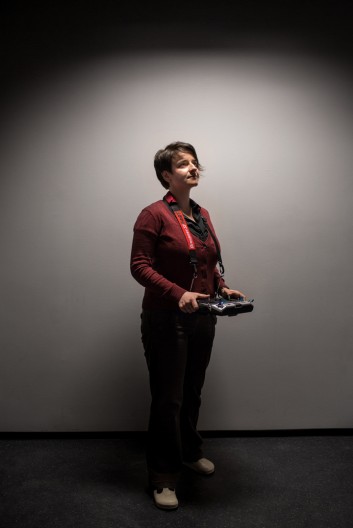
The Vienna team, led by chief engineer Annette Mossel, programmed the quadcopter’s navigation software into the processor using an app.

Once in flight, the UAV uses the phone’s camera to identify QR-like coded squares placed on the floor within a room. These allow it to create a map of the room, so it can subsequently find its way around the space on its own. Ultimately, plans call for it to be able to identify actual objects naturally present in a room (such as tables and chairs) using a Kinect-style depth sensor, and create its map using those.

Annette Mossel and her team


The smartphone bits and pieces are the most expensive components of the quadcopter, with all of its parts together worth less than €1,000 (US$1,333). It is hoped that eventually, a commercial descendant of the aircraft could be used for things such as monitoring illegal forest clearing in developing nations.

Perhaps its price could be brought down further if it came without a processor of its own, and users just docked their own smartphone into it – as is already the case with some small, wheeled robots.

It can be seen in flight in the video below.

Source: Vienna University of Technology

http://vimeo.com/77476282

This documentary details the bureaucratic challenges faced by search and rescue personnel and their desperate need for civilian drones which are restricted by the Federal Aviation Administration (FAA). Countless lives could be saved with this existing and affordable technology, but the government prohibited their use in 2007.

By Gus and Maha Calderon

Video  —  Posted: November 7, 2013 in Drone Benefits, Positive Drone Uses

Commercial drones will soon be populating U.S. airspace, and venture capitalists like Tim Draper are placing their bets.

Draper, an early investor in Hotmail, Skype and Baidu Inc., is now backing DroneDeploy, a startup that’s building software to direct unmanned aircraft on land mapping and the surveillance of agricultural fields. Draper even expects drones to one day bring him dinner.

Drones are moving from the military, where they’ve been used to spy on and kill suspected terrorists, to a range of civilian activities. Photographer: Leigh Vogel/Getty Images

“Drones hold the promise of companies anticipating our every need and delivering without human involvement,” Draper, 55, wrote in an e-mail. “Everything from pizza delivery to personal shopping can be handled by drones.”

Venture investors in the U.S. poured $40.9 million into drone-related startups in the first nine months of this year, more than double the amount for all of 2012, according to data provided to Bloomberg News by PricewaterhouseCoopers and the National Venture Capital Association. Drones are moving from the military, where they’ve been used to spy on and kill suspected terrorists, to a range of civilian activities.

Congress has directed the Federal Aviation Administration to develop a plan to integrate drones into U.S. airspace by 2015 and to move faster on standards for drones weighing less than 55 pounds.

It’s not just startups that are anticipating the changes. ConocoPhillips says that drones could be used to monitor ice floes and marine mammals in the Arctic. Entrants could also include established drone makers AeroVironment Inc. (AVAV), Boeing Co. (BA)’s Insitu unit and Israel Aerospace Industries Ltd. in Tel Aviv, according to Bloomberg Government.

Growth Coming

Sales of civilian unmanned aerial vehicles, or UAVs, will reach $8.2 billion within the decade, up from nothing today, according to Phil Finnegan, director of corporate analysis at researcher Teal Group, which tracks aerospace and defense.

“There’s going to be a lot of growth in this market,” Finnegan said.

While the capital invested in drone-related startups has surged, it’s still concentrated in just a few companies. Three startups account for all of the money raised in the first nine months of this year, compared with five in all of 2012.

Draper backed DroneDeploy through his Menlo Park, California-based firm, Draper Fisher Jurvetson. Airware, a startup in Newport Beach, California, raised $13.3 million earlier this year from investors including Andreessen Horowitz, Google Ventures and First Round Capital to develop customizable autopilots for UAVs that cost about $4,500 to $7,500, according to the company’s website.

Airware found it much easier to attract the attention of venture capitalists this year after testing the product with customers, said Chief Executive Officer Jonathan Downey.

Funding Environment

“We’d looked at raising money last year, and it was very different,” said Downey, who plans to move the company to San Francisco in January.

The business of drones still carries plenty of risks. UAVs will have to occupy parts of the airspace not used by airplanes, and investors don’t yet know what the rules will be. Concerns over privacy are most notable given the history of drones as tools used by the government and military.

The American Civil Liberties Union has warned of the possibility of a “surveillance society” spurred by drones. “The only way to avoid this dystopian future and prevent mass, suspicionless searches of the general population is to ensure that information collected by drones for one purpose cannot be used for another purpose,” Allie Bohm, a strategist for the ACLU, wrote in an August blog post.

Declining Costs

Andy Wheeler, a partner at Google Ventures, said drones are moving into the mainstream because of the steep drop in the cost of sensors, which have been mass produced for smartphones. The plunge in costs helped convince Google Ventures to invest in Airware as well as another drone-related startup, Wheeler said, declining to say which one.

“We are talking orders of magnitude lower than military technology,” Wheeler said, referring to the prices for commercial equipment.

While DroneDeploy is building software and Airware is developing systems, some startups are focusing on services. Matternet Inc., funded by Andreessen Horowitz, aims to use drones for delivery of items such as mail and medical supplies.

Bloomberg LP, the parent of Bloomberg News, is an investor in Andreessen Horowitz.

Firefighters and law enforcement officials are likely to be some of the early beneficiaries of the drop in costs, said Kent Goldman, a partner at First Round Capital in San Francisco.

“I see a bright future for non-military applications,” he said.

Source: http://www.bloomberg.com/news/2013-10-30/drones-delivering-pizza-venture-capitalists-wager-on-it.html
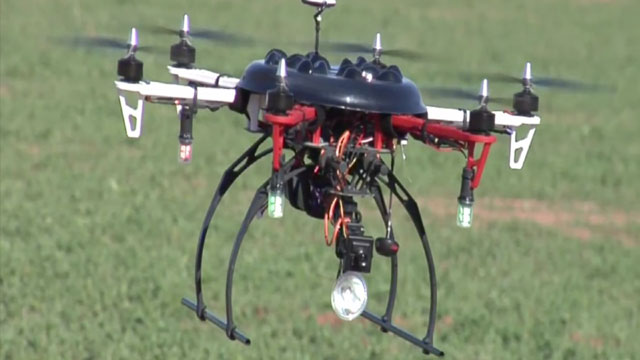
Source: MrHeli444

Australia may soon be the first country in the world to see commercial courier deliveries by drone, if a launch by a textbook rental service and an Australian tech start-up goes according to plan.

From March next year and pending regulatory approval, students will be able to order books from Zookal via an Android smartphone app and have one of six Flirtey drones deliver them to their door in Sydney. As the drone arrives, students will be able to track it in real-time on a Google map.

After its initial launch, Flirtey hopes to then expand the service to other products and locations, even seeing potential to deliver food and drinks to people and blood to and from blood banks and hospitals in future.

When launched, the Flirtey will carry up to 2 kilograms.Couriers in the sky: The Flirtey drone will be used by textbook delivery service Zookal. Photo: Supplied

Textbook rental service Zookal partnered with Flirtey, a start-up born at the University of Sydney, to cut costs on deliveries. If Flirtey gets the approval of Australia’s Civil Aviation Safety Authority (CASA) it will be the first use of fully automated commercial drones for deliveries in the world, the company claims.

Advertisement

Zookal’s founder Ahmed Haider is confident. Australian regulators entered the Drone Age in 2002, when Australia became the first country to introduce legislation covering unmanned aerial vehicles, leading the world in creating rules governing civilian use of the technology.

But whether the company can get CASA’s approval remains to be seen.

The Flirtey drones will come in two sizes.The Flirtey drones will come in two sizes. Photo: Supplied

“I think CASA’s smart,” Haider said. “They recognise that this is going to be one of the next multibillion-dollar industries and they’re taking a sort of proactive rather than reactive approach in laying the foundations for the new industry. So I’m pretty sure … they’re onboard.”

CASA confirmed it had been corresponding with Zookal but an application had not yet been lodged.

Melbourne’s Metropolitan Fire Brigade already uses drones to survey emergency situations and is one of the 56 operators in Australia who have a licence to operate one.  In one recent example, it used a “CyberQuads” drone to survey a truck hanging precariously from a freeway in Melbourne’s north in March. Animal rights activists have also used them to spy on farmers, while Channel Nine’s 60 Minutes used one when it flew over Christmas Island’s immigration detention centre. The craft later crashed into the sea. Another crash occurred earlier this month when a drone collided with the Sydney Harbour Bridge.

The Flirtey drone in the sky.When launched, the Flirtey will carry up to 2 kilograms. Photo: Supplied

A number of companies have attempted to get the drone delivery idea off the ground. Domino’s Pizza sent its “DomiCopter” on a test flight in June in Britain. Tacocopter.com also proposed to deliver tacos in San Francisco’s Bay Area using drones, but commercial drones aren’t yet a possibility in the US and Britain.

The US Federal Aviation Authority acting administrator, Michael Huerta, recently said the agency was poised to realign itself to prepare for the coming explosion of drones. It will begin granting personal and commercial licences in 2015 and estimates that there could be as many as 30,000 drones flying around the US by 2020.

Unlike many amateur drones, such as the AR.Drone, which are steered with a remote control, Flirtey will be autonomous and use “collision avoidance” technology to avoid birds and buildings. It will fly high enough to avoid pedestrians and below 122 metres.

Zookal textbook rental service founder Ahmed Haider, 27, and founder of drone service Flirtey Matthew Sweeny, 26.Zookal textbook rental service founder Ahmed Haider, 27, and founder of drone service Flirtey Matthew Sweeny, 26. Photo: Supplied

“We use laser range finders in terms of mapping out spaces as well as sonar technology,” said Haider. “So it doesn’t actually have a physical camera. It’s connected to GPS on the users’ mobile phone.”

The delivery mechanism allows for textbooks to be safely lowered to the customer without the drone having to leave its hovering height of about three metres. If gentle force is applied to the drone’s lowering cord, the parcel is released.

It has built in redundancy, including a back-up battery, and can also continue to operate if one rotor blade fails.

The app for the Flirtey drone service is seen in this screenshot.
The app for the Flirtey drone service is seen in this screenshot. Photo: Supplied


The drones — which can carry up to 2 kilograms — will significantly reduce the cost of delivering textbooks. Same day postal delivery in Australia can cost up to $29.95, a cost Zookal absorbs, but Flirtey will cost just $2.99.

The drones will also reduce waiting times to as little as two to three minutes, the company claims.

In the future, Flirtey plans to deliver food and drinks; sees potential in using drones at beaches to deliver life vests to those in distress, and in hospitals, where blood could be transported to and from blood banks.

Haider said the idea of delivering textbooks via drones came about after trying to find ways to reduce delivery cost, one of the company’s biggest expenses.

“We immediately saw that commercialising this technology would solve so many problems within logistics.”

Flirtey founder Matt Sweeny said he came up with the idea of using drones while in China where his McDonald’s orders were delivered via bicycle “in moments”.

Should CASA not approve delivery directly to homes, Sweeny said designated “drop off” areas, in places such as parks, might become Plan B.

Unmanned aircraft systems (UAS), colloquially known as “drones,” are fascinating as pieces of technology. But they are not revolutionary. There is little a UAS can do that an airplane or a helicopter can’t. Yet because of their size, remotely-piloted nature and extensive utilization by the military, UASs have captured the public’s attention in a manner that is generally reserved for truly disruptive, world-changing technologies.

This is not good news for the UAS.

Unmanned aircraft are widely valued for their ability to track and kill enemy targets overseas. A recent NBC News/Wall Street Journal poll found that 66 percent of Americans support UAS strikes abroad. But their use has spawned a cottage industry at home trafficking in drone-based paranoia, recently peaking in April with an eight-city drone protest campaign.

Fear and misunderstanding of unmanned aircraft is spreading rapidly, and it is not just at the fringes of society.

We have identified 30 states in which legislatures have passed or are considering bills this year to restrict the ability of public and private organizations to operate unmanned aircraft. Proposed prohibitions range from banning UAS surveillance, banning most aerial photography and requiring public hearings before a law enforcement agency could purchase UAS.

Not all of the proposed legislation is necessarily ill-advised in its content—there must be clear privacy and operational regulations–but the cumulative rush to legislate based on fear is not derived from a rational assessment of the societal costs and benefits of UAS operations.

Why are unmanned aircraft now being viewed as a threat-worthy of SkyNet? Last week’s revelation by FBI Director Robert Mueller to the Senate Judiciary Committee that his agency uses UAS for domestic surveillance on a limited basis will certainly not help. But we believe the true problem, which has been allowed to develop unchecked for too long, is that there is a disconnect between the public and those who build and use unmanned aircraft—and who know their actual capabilities and limitations.

Illustration of the United States Navy’s BAMS unmanned aircraft.


To steal a line from Cool Hand Luke, “what we’ve got here is a failure to communicate.”

Because of this failure to communicate, even as unmanned aircraft rack up innumerable successes for the military and law enforcement, those very successes are slowly poisoning the well of public trust and creating a “not in my backyard” mentality about their use.

Read the rest of this entry »

Preparing To Launch A Drone
This is some Firefly-level futuristic Old West juxtaposition.
3D Robotics, via YouTube

Sometimes it’s hard to get the big picture from the ground. In a vineyard, the color of vines and signs of stress are easier to see, especially for a whole field, from the sky. Today, this kind of aerial surveying for agriculture can be done with an appointment and service fee from a manned airplane or helicopter, but in the future it could all be done by drones the farmers’ themselves own.

DRNK Wines, a vineyard located in Sebastolpol, California, recently had 3D Robotics, the drone company founded by former Wired editor-in-chief Chris Anderson, fly a drone over its fields. 3D Robotics specializes in piloting systems for smaller drones, and the vineyard used 3D Robotics’s route-plotting software for mapping out the drone’s precise path. In just an hour, the drone flew over the field snapping pictures, then stiched together the pictures to create a comprehensive map of the vienyard. Looking over the newly created field map, farmer Ryan Kunde noticed two things he expected, and one he didn’t. The top of the hill had darker vines, indictating more water and better soil, than the lower slopes. That variation was expected. Unexpected was a fertile crescent at the bottom of the hill, with darker vines indictating a second especially good growing patch. With that knowledge, Kunde sampled grapes from the crescent, and decided which part of his crop to harvest first.

Watch a video of the flight and the farmers below:

http://www.youtube.com/watch?v=ZWmzbLlHq9g

NASA uses drones in some of its programs. 

Privacy concerns, integration into the national airspace and spectrum allocation are the big three obstacles to wider deployment of unmanned aerial vehicle technologies. Like any new technology that develops faster than the speed of policy, lawmakers, lawyers and others grappling with these issues should not allow them to curtail the benefits of UAVs.

Who would have thought in the 1950s that room-size computers would spawn new areas of law and new questions around intellectual property and warfare? Finding creative ways to manage equally innovative UAV technologies involves similar hurdles. Innovative technologists and business leaders had the vision to harness the benefits of computers, while taking on the contemporary issues they raised. We are in the middle of doing the same with UAVs.

Unmanned but not unpiloted, UAVs are commonly referred to as “drones,” which implies the absence of an intelligent human operator. In fact, satellite and ground control stations feed a large amount of data to remote UAV pilots to inform their decisions. As is widely reported, the U.S. military uses UAVs in theater now and has been successfully using them for decades.

The public knows less about civilian uses of UAV technology. The Aerospace Industries Association released a report recently to address the perceptions and potential of UAVs. They noted that domestic applications are predicted to include search and rescue, law enforcement, weather forecasting, border patrol, firefighting, disaster response, precision farming, commercial fisheries, scientific research, aerial photography, mail delivery, communications relay, infrastructure monitoring and emergency management.

The corresponding benefits are more accurate weather forecasts, safer streets, bumper crops, fewer Americans engaged in dangerous jobs, more dangerous fugitives apprehended and reduced risk to firefighters.

Benefits to society result not just from UAV platform technology, but the sensors they carry – sensors that can be applied to saving lives after a natural disaster; providing situational awareness during wildfires; capturing real time information about the impact of oil spills; and protecting the security of our border by identifying the trafficking of weapons or drugs.  These are but a few of the applications drones have to positively affect society on a global level.

Two recent nationwide surveys indicate widespread public support of UAVs.

A Duke University survey found 57 percent of the public supports their use for any application and an even higher percentage support specific applications, including search and rescue operations (88 percent). Also, 74 percent of those polled by the Christian Science Monitor said they support nonmilitary domestic use of UAVs provided individual privacy concerns and ground safety issues are met.

In June during a Senate Judiciary Committee hearing, FBI Director Robert Mueller admitted the FBI has used unmanned aerial systems for U.S. domestic surveillance. In a follow-up letter responding to a query from Sen. Rand Paul, the FBI said the agency uses UAVs in limited circumstances when there is a specific operational need.

The letter goes on to outline several rules and regulations the FBI follows when using UAVs, including obtaining Federal Aviation Administration approval. Each UAV surveillance request also undergoes the scrutiny of FBI legal counsel to ensure there are no Fourth Amendment or privacy concerns prior to senior FBI leaders approving. In cases where there is an expectation of privacy, the agency must also obtain a search warrant. So far, according to the letter, none have been needed.

Most of the letter’s content defensively centers around the process the FBI follows when using drones. It also spends three sentences on the reasons why it has used them: for surveillance to support missions related to kidnappings, search and rescue operations, drug interdictions and fugitive investigations. This is where the UAV debate should center, on finding ways to exploit the potential of UAVs while safeguarding civil liberties.

Just this past July, the FAA certified the first two U.S. UAVs for restricted use in commercial airspace, pending airworthiness certification. The FAA has been willing to work with industry, including my company, to develop the infrastructure and technology needed to ensure safe and efficient adaptation from military to commercial use in the national airspace system. And it is also willing to establish a vision that will serve the needs of all stakeholders, while ensuring the safety of our airspace.

We must build on this progress. Under Congressional stewardship, a commission comprised of technologists, legal and FAA representatives and stakeholder beneficiaries should study and recommend how we leverage the benefits of UAVs while addressing the big three obstacles.

UAV technology is ready and the needs exist.  We are at the convergence of innovative UAV platforms of all sizes and capabilities, with sensor and computing technologies that will enable us to meet the needs of many markets.  There is public support. What we need now is a path forward.

Source: http://www.nextgov.com/defense/2013/09/commentary-how-drones-can-help/70728/?goback=.gde_115534_member_276589613#!

Join us for UAV Day at the Reuben H. Fleet Science Center in San Diego, California on Sunday, October 6, 10 a.m. to 4 p.m., and meet local experts in this new and ever-diversifying field of technology. In conjunction with our exhibition, On the Fly: Technology Takes Off, the Fleet is celebrating San Diego’s innovative UAV and multi-rotor community by inviting local organizations to join us for UAV Day. They will display small multi-rotor aircraft, custom and commercial UAVs and autonomous RC planes and helicopters for hobbyists. Most will also bring videos with information about their creations, their organizations and UAV technology and its myriad applications.

You may even take home your own quadcopter! All attendees can enter to win an AR.Drone2.0, the one-of-a kind quadcopter developed by French company Parrot featured in our exhibit. Parrot AR.Drone2.0 are very robust and stable, can be controlled by Wi-Fi using a smartphone or a tablet and are equipped with an embedded high-definition camera enabling video and photo recording and sharing.

quadrotor_1

A quadrotor in action.

There will be brief lectures for interested visitors on the history and development of unmanned aircraft history and its civil integration, current FAA restrictions on commercial usages for UAVs and the positive applications being developed for UAVs and quadcopters.  Join in a workshop on unmanned technology, take a pilot lesson on a quad simulator and see how they function in an interactive mini wind tunnel.

In conjunction with the lectures, catch a new documentary making the rounds of film festival,s now titled Civilian DronesSearch and Rescue, based on a Texas man who has been doing recovery work with multi-rotors in the desert for the past ten years. The Air Law Institute is sponsoring a group of kids from an Old Town engineering scholarship program, who plan on building a scale model of NASA’s Ikhana unmanned aircraft. And don’t miss the clown and ghost quads, just in time for Halloween! Many of the multi-rotors and related products will be available for sale as well.

Participants thus far include AUVSI San Diego, Air Law institute, Innovative Designs, Dr. Eric Frost, 3D Robotics, San Diego Wind Tunnel, Isis Copter, Go Professional Cases, MultiRotor Systems and San Diego Drone User Group.

All activities are free with Fleet gallery admission.

Source: http://www.rhfleet.org/events/uav-day#sthash.sv1Rw2VW.dpuf

noaa-puma

NOAA has begun testing unmanned aircraft in the Olympic Coast National Marine Sanctuary that could allow researchers to observe animals at relatively close range with minimal disturbance, and possibly locate marine debris in remote areas.

The test of the Puma system, which can fly lower and slower than manned aircraft and are much quieter, is taking place in and around the sanctuary through June 29 and is the first test of unmanned aircraft for use in the Olympic Coast.

During the test, the aircraft is launched and recovered from the research vessel Tatoosh. The test mission will demonstrate the aircraft’s camera resolution and allow researchers to explore the aircraft’s potential to support management of Olympic Coast National Marine Sanctuary, the Washington Maritime National Wildlife Refuge Complex and other marine resource trustees.

“The primary objective of the tests is to monitor seabird colonies along the coastline and offshore islands of Olympic Coast National Marine Sanctuary,” said Carol Bernthal, sanctuary superintendent. “We also plan to survey remote coastline and open waters for marine debris and other marine wildlife.”

The Puma is a 13-pound, battery-powered aircraft that can be hand-launched from any location on land or at sea from a boat and is controlled remotely. The aircraft can fly for up to two hours on a charge and cover a range of about 50 square miles.

If successful, unmanned aircraft technology could be used in marine protected areas worldwide.

Agencies throughout the state, including Grays Harbor, have submitted a proposal for a drone research and testing facility in Washington. The proposal provides a testing range over the Pacific Ocean near Grays Harbor for those developers needing “blue water” testing capability.

The final decisions for the flight center are scheduled to be made before December 31, 2013.

Source: http://www.suasnews.com/2013/06/23508/unmanned-drones-are-being-tested-on-the-olympic-peninsula/

Take_off

A hearty congratulations to Paul Braun whose Kickstarter project was designed to bring joy to others. He has succeeded in his goal and autistic children have built and flown their own drone. With it learning some of the freedoms that come with flight and journeys into their imagination of what they might see. Once they had been taught they had the opportunity to see the earth from the sky for themselves.

The sUAS News hat is firmly tipped to Paul and the team.

“Probably the best way to understand the TATTS project is to read and watch the original post  that we used on KickStarter to spark the awesome fund raising campaign.  That being said, the project continues to evolve as we get new ideas from the kids themselves, parents of those involved and others.  Our current thinking is TATTS is a 3 phase project:

  1. Build the hexarotor
  2. Fly it
  3. Make the movie

The kids have learned to fly on a simulator, built the hexarotor from scratch and successfully flown almost a dozen missions.  We’ve collected a great deal of experiences as well as lots of fantastic video.  Our final step in the project was to make project videos.  One aspect of that was to allow the kids to make their own movie from all the footage.

What kind of movie would you produce if you had 4 GB worth of video footage, several hundred still shots and dozens of songs?  I can guarantee that each movie would be different.  That’s certainly the case with the movies that the kids produced.  They are anywhere from 2-6 minutes each and have only tapped into a portion of all the great footage.  I’d urge you to take the time to watch them.

What amazes me is some of the similarities and stark differences in what each of them produced.  Most kids included the clips of crashing (lots of use of the term ‘epic fail’) and they all tended to include footage of themselves.  Who wouldn’t right?”

Source:  http://www.suasnews.com/2013/09/24944/taking-autism-to-the-sky-tatts-project-children-take-flight/

Read More: http://taking-autism-to-the-sky.blogspot.com/

Like an army, science needs the high ground. This is true when it comes to oil exploration and especially so in the rugged landscape of Norway. The Virtual Outcrop Geology (VOG) group at the Norwegian Centre for integrated petroleum research (CIPR) is working to capture this vantage point in a distinctly 21st century way, by using UAVs to seek out oil by helping geologists build 3D models of the terrain.

We tend to think of oil exploration as taking place on desert plains or out in the ocean, but finding oil deposits depends on having a comprehensive understanding of local geology, which is one reason why the question of how much oil we have left sparks so much argument – there’s still so much we don’t know about most of the Earth. By studying the Norwegian terrain and matching it up with other data, such as that gathered from seismographs and core drilling, geologists can build up a three-dimensional picture of what’s going on beneath the ground – both on land and under the sea.

girl
Researcher Aleksandra Sima at Bergen’s CIPR with drone controls

Read the rest of this entry »

This month’s Popular Mechanics has a cover article that discusses many of the hot topics that surround Drones and UAV’s today. It is worth picking up and would be a good primer for anyone new to the topic. The article goes into a good amount of detail about current FAA regulations and how they are being pushed to change and adapt to what is becoming a growing number of commercial uses of drones..

popularmechanics


Source: http://www.popularmechanics.com


In the wake of the recent floods in Colorado, Falcon UAV has spent the last three days providing volunteer aerial services to the Boulder County Emergency Operations Center (EOC) and the Incident Management Team (IMT).  On Thursday afternoon while all National Guard aircraft were grounded due to weather Falcon UAV was proud to have been the only aircraft that was able to take flight to support the flood efforts in Lyons.

Friday saw a reprieve in the weather and we are able to get a perfect flight off in the town of Longmont to capture aerial imagery for damage assesment at the intersection of the overflowing St Vrain river and equally inundated Left Hand Creek.   In less than an hour the imagery was processed and provided to the Boulder EOC.  Just as Falcon UAV was off to another damage assessment in Lyons, Colorado we were requested to standdown for National Guard helicopters now supporting evacuation efforts.

Enter FEMA…….

Early Saturday morning Falcon UAV was heading up to Lyons to complete a damage assessment mapping flight when we received a call from our Boulder EOC point of contact who notified us that FEMA had taken over operations and our request to fly drones was not only denied but more specifically we were told by FEMA that anyone flying drones would be arrested.  Not being one to bow to federal bureaucrats we still went up to Lyons to do a site survey for how we can conduct a mission in the near future to provide an adequate damage assessment to this storm raveged community.

Where bridge to the south side of Lyons used to be

Road into Lyons, CO

While we were up there we noticed that Civil Air Patrol and private aircraft were authorized to fly over the small town tucked into the base of Rockies.  Unfortunately due to the high terrain around Lyons and large turn radius of manned aircraft they were flying well out of a useful visual range and didn’t employ cameras or live video feed to support the recovery effort.  Meanwhile we were grounded on the Lyons high school football field with two Falcons that could have mapped the entire town in less than 30 minutes with another few hours to process the data providing a near real time map of the entire town.

Falcon UAV would like to thank the Boulder County EOC and specifically Allen Bishop and Michael Chard (while they were running operations) for their common sense approach to drone operations, working to coordinate the airspace, as well as embracing this technology to help support the recovery effort.  In contrast we are very disappointed in FEMAs response to actively prevent the use of UAVs and drone technology when these services were offered for free and at a time when manned helicopters could be used for more critical missions such as evacuations and high mountain search and rescues in inaccessible communities.

Source: http://www.suasnews.com/2013/09/25059/falcon-uav-supports-colorado-flooding-until-grounded-by-fema/

A drone the size of a small Cessna plane buzzing over the massive Rim fire has become a valuable tool as commanders use its real-time imagery to strategize their next move.

The remotely piloted plane began flying Wednesday morning after Incident Cmdr. Mike Wilkins requested the MQ-1 aircraft belonging to the California Air National Guard. It has since been giving fire commanders a bird’s-eye view of the 300-square-mile blaze in and around Yosemite National Park, which is now the sixth largest fire in state history.

Unmanned aircraft have been used sparingly on fires but are gaining value as a cheaper, more efficient tool for fire commanders to better understand how fires are behaving.

They are prized for their ability to beam real-time pictures directly to fire commanders, who can make tactical adjustments more quickly. The aircraft are equipped with infrared heat sensors and a swiveling camera operated remotely.

During a 20-hour mission Wednesday, the drone — taking off from the Victorville airport and operated from March Air Reserve Base in Riverside — alerted crews to a spot fire and provided a more comprehensive fire map.

PHOTOS: Rim fire rages into Yosemite

Unlike manned planes and helicopters, drones are not grounded at night or unable to fly in high winds or smoke. They fly at about 18,000 feet and cost about $800 an hour to operate, Keegan said.

There are now 4,840 firefighters battling the Rim fire, which has been burning in the Stanislaus National Forest for nearly two weeks.

The blaze is 30% contained and has cost nearly $40 million to fight so far, officials said. The fire has burned about 301 square miles, an area bigger than Chicago or San Francisco, and destroyed at least 111 structures.

Fire crews in Yosemite were hoping to slow advancing flames by conducting large-scale backfire operations from Hetch Hetchy Reservoir south to Tioga Road.

The rate of spread of the massive fire has slowed in recent days and firefighters expect to have it fully contained by Sept. 10, officials said.

Source: http://www.latimes.com/local/lanow/la-me-ln-drone-providing-yosemite-fire-commanders-with-birdseye-view-20130829,0,6826104.story